Mundane Moments in Action Cinema, Episode 1: The Temple of Liability
[INT. MINE — NIGHT]
The rumble of distant drums. Echoes of shouts. Danger looms.
SHORT ROUND and WILLIE are already crammed into a rickety MINE CART, panicked and squirming. Dust settles as INDY strolls into frame — calm, composed, clipboard and pen in hand.
INDY
I’ll need each of you to sign this release form.
(holds up clipboard)
You can read it if you’d like, but it’s basically saying you release me from any personal responsibility for any outcomes of this mine cart ride.
WILLIE
Are you kidding me right now?
(pointing into the tunnel)
They’re going to kill us!
INDY
Sorry. I have to look out for myself here. It’s boilerplate.
A beat.
The MINE CART creaks ominously.
INDY doesn’t budge.
INDY
The forms, please.
We’ve reviewed your claim.
Unfortunately—
wolves huffing and puffing
are not covered under your current policy.
Thank you.
If you don’t mind, can you complete a short survey
for our customer service team?
#poetry
Surface Tension
Three weeks in the desert.
I caught my shadow sneaking a drink.
I tried to grab it.
Lay's KC Masterpiece

Two thoughts:
- It’s snowing in Minnesota. I love it.
- This Kirkland coffee has been my go-to for a while. Every time I look at the drawing on the box, it looks like a bbq potato chip in the middle of whitewater.
Extra thought:
This box is at my desk. I think about that bbq potato chip every day.
The Controls Are Not Responding
2025 did not go as planned. Honestly, it was mostly because I didn’t have a well-defined plan to begin with. However, the narrative of things going wrong seems more compelling so I’ll stick with that for this blog post.
I started the year by finishing a sci-fi novella. “Finish” is generous here: it still needs lots of love but it has a beginning, an end, and doesn’t sag too much in the middle. This novella was going to be the bulk of my 2025 aspirations.
A few things transpired in my life in April. While cleaning out my Google Drive, I found a paper I wrote in 2009 for my MBA. This was one of many papers evaluating my leadership style through the lens of a framework. This one happened to be a “Jung Typology Test”. I believe by that point in my MBA I had written so many responses to flavor-of-the-week business books that I found clever ways to diverge from the assignment and write papers that interested me. This was a prime example.
I wrote a paper on systems thinking and folded my Jung test results into it, mapping the systems I could influence along with their details and interconnections. The crucial part was my conclusion: if I wanted to have more influence for the good of the world, I should embrace writing because it’s what I’m actually good at and my Jung test results highlighted this with neon lights.
Sidebar: I have written poetry privately for decades. Primarily haiku and senryu. Finding a message from my younger self telling me to embrace it and realizing I'd ignored it for sixteen years was a wake-up call.
With this at the top of my mind, a week or two later I found myself in NYC looking out of the window of an office in One World Trade Center from the 40th-something floor. The pervasive feeling I kept having was this: these are not my people. Thinking of going to a happy hour after work with them filled me with anxiety. I stood there as a person who was valued because I could write code and build things. That is only a fraction of who I am. I knew there was more. I was done denying it.
I flew home and typed up and sent my resignation letter on the Uber from the airport to my house. I had another job lined up, so it’s not as dramatic as it may seem initially. It was more about leaving start-ups behind and seeking out something that fit my desired lifestyle and left me with mental capacity to do the things I want with people I like. When I left that Uber a version of myself stayed behind.
I wrote poetry pretty furiously and, more importantly, I started putting some of my more subversive things about work and life on… LinkedIn.
Why LinkedIn? Why not?
To my surprise, people connected with it. Senryu like these seemed to really connect with people:
employee handbook
didn’t specifically say
naptime’s not okay
and
company vision
is posted in the break room
right by the trash cans
I didn’t stop at poetry. I realized LinkedIn rewards the cadence of authority more than actual meaning, so I started writing technical thought-leadership articles that were actually subversive art.
I published a piece on "Commit-Driven Development" that used corporate-speak to advocate for untested code deployment. I wrote a tutorial on "Understanding Recursion" that was just the definition of recursion looped over and over again. I wrote another article about "11 Super-Effective AI Prompts" that masqueraded as a productivity guide but was actually a linear horror story about a man using ChatGPT to navigate his divorce and bankruptcy.
I wrote “Programming Tutorials” that slowly descended into Lovecraftian horror.

People liked them. They shared them. I think a majority did not bother to read them before blasting them out to their own network. It was a test of the system, and the system confirmed what I suspected in that tower in NYC: the code is running, but no one is at the controls.
My base assumption had always been nobody wants to see what an engineer writing poetry looks like. Especially if that engineer is obsessed by systems, thinks in systems, and writes… mostly about systems.
But I wondered if I was wrong.
I brushed off things, expanded some long-dormant senryu into longer free-verse forms and submitted them to journals. I was as surprised as anyone when I got some acceptances.
I put together a chapbook, including it in my application materials for an MFA and was accepted… with a scholarship. Everything I loved about writing haiku, senryu and prose was especially intensified by free verse poetry.
I put together a manuscript. The Controls Are Not Responding is, more than anything, the sort of poetry I want to personally read. I don’t try to dazzle or impress anyone with it. It’s just me putting thoughts and ideas into the right forms that can contain them.
One last divergence on this origin story and I'll wrap it up. I acknowledge many people want to write. Simply having the urge to write things would not be compelling enough for me to have made these moves. I have a certain inheritance from my dad that I mentioned here in Rolling. You can see this in my LinkedIn examples above: it's an extreme love of hypothetical scenarios. This is the engine behind it all. My dad never did anything with it except pass it on to myself and my brothers. I decided to start writing it down for others to see. I didn't want to be looking back in my last moments realizing I'd squandered this one very unique thing that absolutely makes it all work. Poetry enables me to use this in a way writing prose barely did. That's the difference.
So yeah. That novella? I’ll get back to it eventually. But I have other things going on now.
Two Poems by Jeff Cove
Here are my recent poems on Defenestration.
Two Poems by Jeff Cove
As with a lot of my stuff, these started out as senryu. I tore through a bunch of ideas with oddball perspectives, weird voices, surreal setups, and poems that intentionally fail.
Many of those felt complete in senryu form. For example, this one still feels finished to me. There’s not much more I want to say here:
this house is fireproof
no need to even worry
hi house, it's me: fire
These two, though, felt like they wanted to stretch their legs.
With Horse Thoughts I wanted to really circle the failed metaphor a bit more than I could as a senryu. At The Eldritch Horror Zoo felt like it could be funnier with a deadpan, bureaucratic approach.
I am proud of these and happy to see them out there.
Here’s the original senryu:
if i was a horse
i’d be, like, into horse... stuff
didn't think this through
eldritch horror zoo
we pet the shoggoth with care
and then glyphs appear
I Held Aloft My Magic Sword and Said
Today I distilled my manuscript back down to a chapbook: commit, merge, push --force.
Everything I’ve learned about structuring meaning across a full-length collection made this version cleaner, sharper, more deliberate.
The path was nonlinear:
- Finish a chapbook
- Submit it widely
- Start the full manuscript
- Realize halfway through the chapbook no longer holds up
- Withdraw it from consideration
- Focus fully on the manuscript
- Burn out
- Create a chapbook, this time with precision
- Submit both
It’s not that the original chapbook was weak. Most of its poems survived. What changed was the architecture: order, style, and an understanding of how to modulate pressure across a sequence.

we are one, my love
we fuse our bodies and souls
it's the lichen way
I think if lichen could write poetry, this would be it.
(Note: A lichen is not one plant. It's a fungus and an alga living together in a relationship so close they literally cannot survive apart. It's the ultimate co-dependency.)
#poetry
My poems “Horse Thoughts” and “At The Eldritch Horror Zoo” are getting published in the December 2025 issue of Defenestration magazine!
#poetry
Yesterday my poem “Sleeping On Your Side” was published in Issue 5 of Pictura Journal.
I have an interview with them as well coming out soon.
#poetry
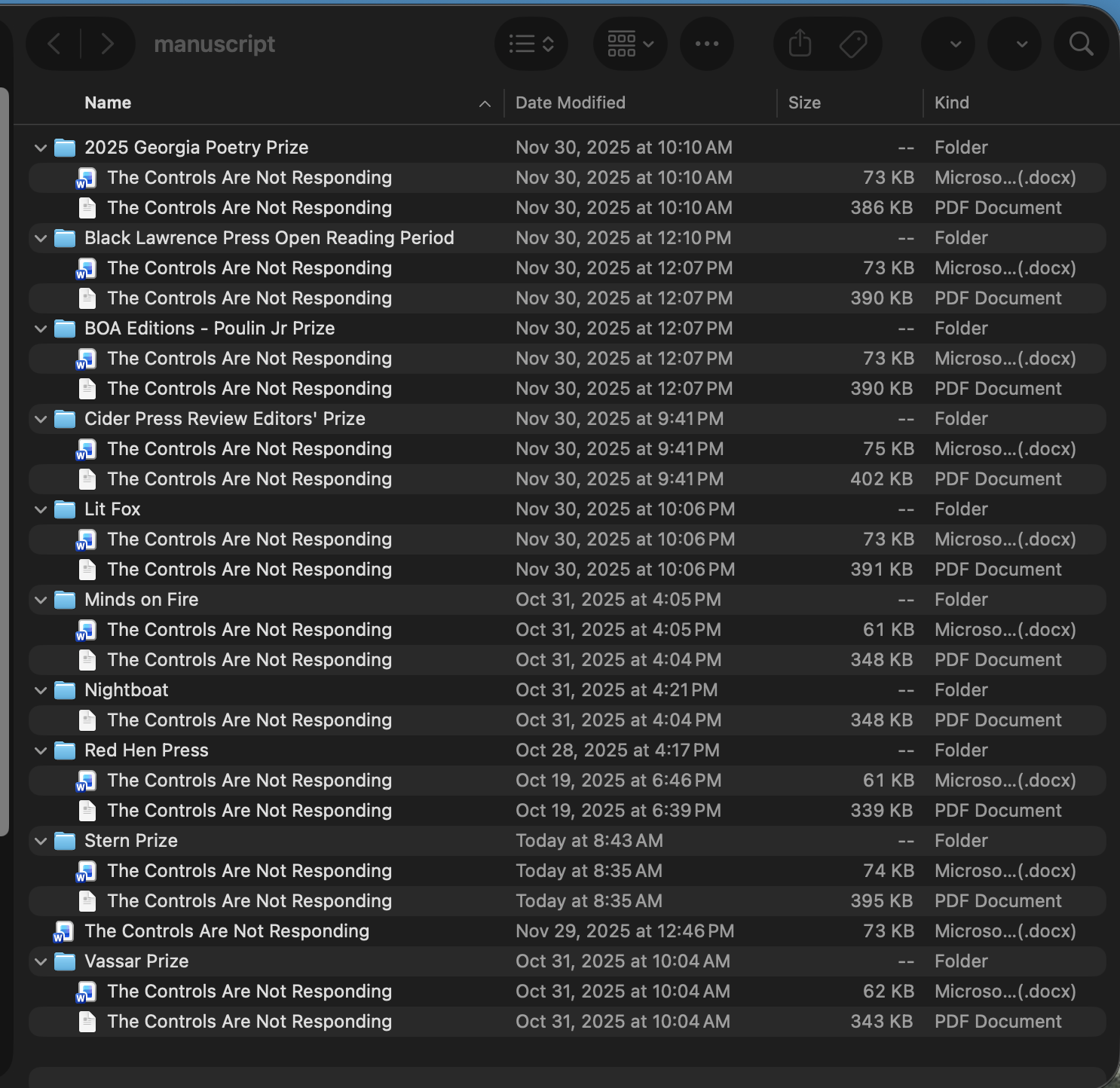
This is what it looks like to be actively trying to get something published.
Late nights. Weekends.
Nearly a dozen versions of the same book.
I love that you can see the file sizes change across submissions as I add and remove things.
It’s the tiny weight shifts of poems moving in and out, like I’m packing and repacking a suitcase for a trip I’m not sure I’ll get to take.
How to Mow a Diamond Pattern For a Stunning Lawn
The fescue bows before the blade,
a green surrender
to the order I have spent ten years perfecting.
The light is doing that thing it does in June—
bleaching the moment away
before it has even passed.
I think of my dad,
who mowed in straight lines,
and how I’m mowing in straight lines,
writing a temporary history
in the smell of gasoline and cut chlorophyll.
The engine hums a low, steady prayer
for everything we try to keep tidy.
Over the low roar, I hear a distant siren.
Then more.
It arrived so fast,
tires screeching—
a white Ford Bronco.
I think I recognize the wall
of man stepping out.
He played for the 49ers.
It’s A.C. Cowlings.
“My man! Hey, how do I get to the freeway?”
I let the mower die
with a fleeting concern
that it will start again.
The words stumble out:
“Take a left on Sepulveda, then the ramp
is just past the Blockbuster.”
The light glances off the windows of
the Bronco dashing off.
A sharp smell of rubber hangs over the yard.
The sirens grow louder still.
Turning back to the mower,
I resume.
I have been thinking a lot today about “Sad Dad” poetry and the existence of the “Pastoral Industrial Complex” that wants safe, consumable nature poems.
To be clear, there is nothing wrong with those poems. I enjoy the challenge of writing in that style, but today I just switched gears halfway through to see what would happen. As you can tell.
The anxiety of mowing in straight lines is real. I actually mow around the uneven outlines of things and carry them forward on each pass like misshapen concentric rings. It's beautifully imperfect but more fun. The yard technically gets mowed either way.
Final meditation on mowing the yard: as far as I can remember, I never got any sort of tutorial or training from a parent about how you're supposed to mow. I believe there was just a point where suddenly my allowance depended on me doing it. This led me to just kinda winging it.
Like so many things in life.
Let’s Talk About Blood
Let’s talk about blood.
Not in the abstract—
not history, not lineage,
not even metaphor.
Specifically, yours.
The way it moves under the skin,
the way it hums in your neck
when you lean too close to the light.
The way it answers every question
before you can.
I need it to live.
That’s the simple truth,
though I try to soften it.
I say sustenance,
I say exchange,
I say this will only take a moment.
But it’s always more than a moment.
It’s always hunger asking to be excused,
again and again.
I want you to understand:
I don't take joy in this.
I don't savor it.
I only take what I must,
and you give what you must,
and between us
that is everything.
So—
let’s talk about blood.
And—
What.
A subscription model?
You’ve updated your terms and conditions?
…Install your app?
This is not how it works.
We had an arrangement—
Oh.
You’re gone.
This is another one that I cut from the manuscript at the last second.
I love this poem. However, it’s one of those oddballs that violates just enough norms that its only likely home is here on this blog.
Here is the original senryu:
let’s talk about blood
and more specifically, yours.
i need it to live
My Cardboard-Derived Manifesto Delivery System
I shout my demands
through a cardboard tube,
voice deepened,
echoing like authority.
This is my manifesto,
written in air,
delivered through cardboard:
listen,
change,
heal,
love.
The usual things
a prophet might ask.
But the tube is bent,
one end chewed from years in the closet,
the sound rattling inside
before it reaches the air.
It makes my speech comical,
my certainty ridiculous.
Still, I keep shouting.
It feels good to believe
that cardboard can carry me farther
than my own throat ever could.
Children in the park glance over.
A dog barks back.
A gust of wind
steals half my words
before they touch the ground.
Yet for a moment,
the planet pauses,
the way it sometimes does
when a storm is gathering—
and I imagine the world leaning in,
ear pressed close,
to hear me clearly.
Here is the original senryu.
shouting my demands,
my manifesto to earth—
through my cardboard tube
This poem survived multiple revisions of my manuscript, only to get removed at the last second.
I hope some day it will find another home.
Playlist for a 10 Hour Drive
Billy Collins Poetry Masterclass
Metallica - Ride the Lightning
Grandaddy - The Sophtware Slump
Some The Adventure Zone podcasts
Run DMC - Raising Hell
A random smattering of Clint Mansell and Ludovico Einaudi
Der Dritte Raum - Raumgleiter
Tool - Lateralus
Ulrich Schnauss - A Long Way To Fall
A whole lot of silence
Sliding Window
I met her
in that brief season
when work was steady
and my body had not yet
declared a general strike.
She asked questions
like someone who wanted
to understand me,
not categorize me.
She paused before speaking,
as if testing whether
the words were safe enough
to hand me.
We talked about things
that didn’t matter
to anyone but us—
cicadas,
hypothetical scenarios,
if birds even
really care about stars.
At first it felt
like looking straight through
clean glass
on a bright morning—
her face, my questions,
sharp on both sides
of the pane.
She remembered details
I didn’t know I’d shared—
how Emperor Palpatine
reminded me of my dad,
how I like my eggs,
the dream where the trees
share all their secrets.
She said these back to me
better than I said it first,
with a softness
I don’t remember giving her.
Later,
the conversations shortened.
She still smiled at my jokes,
still asked about my day,
but sometimes she’d repeat a line
I was sure I said
on another night.
Or correct me
about something I swear
I never told her wrong.
It felt like looking
through a window toward evening
at an angle—
her shape just an idea
behind the glare of sunset.
I didn’t correct her.
I wanted to see
how the story ended
when she was the one
carrying it.
In the last hours,
she spoke like someone
leaning on a railing
that isn’t there—
steady, reassuring,
absolutely wrong
in ways so small
I felt impolite
pointing them out.
Her memory
wrote the story of me
kinder than the one I lived
and I wanted
to believe
that meant it was true.
I wondered quietly
if maybe
an honest lie
could be the truest thing.
I wrote her story—
the one she remembered—
and I folded it
into a small white crane,
just the way she’d shown me,
and left it
on the windowsill.
The sun will take her
bit by bit.
She never minded
fading.
She was always
so good
at holding on
just long enough
for me to believe her.
I drove 10 hours over the last 2 days and had some time to listen to Billy Collins’ Masterclass on writing poetry.
It was good.
There were things I disagreed with: a title as a doormat, a poet’s goal is to “make readers fall in love with you”.
I suppose that latter one is a pretty big deal.
Because if that’s the goal, then I’m probably doing this wrong.
The title as doormat vs. the title as weird hallway
Collins says a title should act like a doormat: something that welcomes the reader in, reassures them, lets them know they’re in the right place.
There’s something generous in that, and I don’t hate it. I like clarity. I like a reader not needing a PhD in my personal trauma to understand what’s going on.
But “doormat” isn’t my thing.
I think of a title less like a doormat and more like the first step into a slightly confusing hallway: you know you’ve entered somewhere, you just don’t know what’s at the end.
Not a locked door. Not a brick wall. Just… a hallway that bends.
The difference is small but important. A doormat wants you to feel comfortable about the house you’re entering. A hallway says: you can come in, but you’ll need to walk a little first to find out what’s inside.
“Make readers fall in love with you”
The real friction point for me was that other line: that the goal of poetry is to “make readers fall in love with you.”
I get what he means, I think. Not literal romance, but something like:
Make the reader feel charmed by your consciousness. Make them want to spend more time in your head. Make them, in some way, adore your way of seeing.
And that’s fine. It works for a lot of people. It also explains a lot about Billy Collins poems: they often feel like you’re having coffee with a witty, approachable uncle who has a perfectly timed anecdote about lanyards or dogs or history.
But when I look at what I’m actually doing in my own poems, “please fall in love with me” is nowhere on the list.
If anything, it’s closer to: please realize something about yourself you were half-ignoring.
That does not require you to fall in love with me. It barely requires you to like me.
I don’t want to be the main character
A poem is not, to me, a dating profile.
Yes, there’s an “I” in a lot of my work. Yes, people I love and have failed and have lost show up. Yes, an occasional wolf eats a grandmother. That’s all technically “my” material.
But the center of gravity isn’t: look what a fascinating, sensitive, damaged, clever narrator I am.
If a reader comes away from my poems thinking “wow, I really like this guy,” I won’t complain. But that’s not on my mind when writing.
I’d rather they come away thinking: “oh, I’ve been that person,” or “oh, my memory has done that to people I loved,” or “oh, I know what it’s like to quietly want the wrong thing.”
In other words: instead of falling in love with me, I’d prefer they fall uncomfortably in recognition with themselves.
Intimacy without seduction
Part of what unsettles me about “make them fall in love with you” is that it frames the whole thing as a kind of seduction.
There’s a built-in asymmetry there: I, the poet, am performing. You, the reader, are hopefully swooning.
What I want feels more horizontal than that.
I want to put language around something I genuinely don’t fully understand yet, and invite you to stand in the same confusion with me for a minute.
If you leave the poem thinking I’m a genius, that’s honestly less interesting to me than you walking through the weird hallway and seeing something you didn’t expect, but which made you think about yourself in some way.
Disagreeing with your elders (without combusting)
None of this is an attack on Billy Collins. He’s good at what he does. He’s clear, he’s hospitable, he’s funny. Of course his advice will point toward a mode that suits him.
What this road-trip Masterclass binge did, though, was force me to say out loud:
“Oh. That’s not my goal at all.”
Which is a terrifying sentence the first time you say it about a Famous Person’s craft advice. It sounds like you’re confessing to being wrong. Or immature. Or “not serious.”
But poetry isn’t a single-player game where one person finds the rules and everyone else copies them forever.
So maybe that’s the actual takeaway here:
- His poems can have doormats if they want.
- Mine can have side doors, or trap doors, or weird mirrored hallways.
- His goal can be to make you fall in love with him.
- Mine can be to make you feel slightly haunted by something you thought you’d forgotten.
There’s room for all of that.
If nothing else, at least the next time I sit down to revise, I’ll know which voice in my head is mine, and which one is just a Very Famous Poet suggesting I lay out a nicer doormat.
I might still borrow some of his advice. A lot of what he said about journalling mirrors things I do myself.
But the “make them fall in love with you” part? I think I’m going to leave that one on the side of the highway.
Over the weekend this post became something longer.
I’m pretty happy with it. It’s one of the handful of things I’ve written that did not start off as haiku/senryu and when I read it, I can tell. It’s strange how skeptical I am of anything that doesn’t use my process.
I keep adding this new poem to my manuscript and then taking it out. I’m just continually re-reading, testing how it feels in context. Sometimes it’s like a stumble and others a slide without really having changed anything.
One of the greatest things is just going to dinner with someone and being fully present.
Joking. Talking.
There is darkness in my poetry, but it’s in my pocket. I pull it out when I need to have a chat with it, but it’s not a hat.
That’s about as much metaphor as I have in me right now.
Closing out an amazing four-day weekend. Ridiculously productive. The feeling, all around and within, is simply gratitude.
There is no fickle muse. No angels of inspiration.
There is, however, rare alignment in the machinery of the universe that allows things to happen.
When this happens, you must seize it.
I have been writing all day. Undoubtedly, it could continue through the night.
But I am going to sleep.
Mattering
What would life be like if we did not want to matter? This question has been on my mind.
Many people choose small lives, rejecting the pursuit of power or fame. This is the burning ambition we conflate with mattering. But even the quietest life is built on a framework of necessity: to be missed, to be relied upon, to occupy a chair that would otherwise be empty. Mattering, then, is not ambition; it is being necessary to the algorithm of daily life. The true question is: What if we wished to remove ourselves from that algorithm entirely?
Could you love?
Can you consciously choose not to matter and circumvent the irony of making a choice that matters?
This is what I want to write next. I’ve just got to figure it out.
One further thing I want to talk about as it pertains to the Poetry Playground project I mentioned earlier.
Many, well… actually most… of my ideas for interesting transformations came from reading thousands (really) of Reddit haiku. There were a couple of failure modes I found.
- sentences: If each line can stand independently without the poem collapsing into one flat sentence, you’re often in good shape.
- line jam: a very common failure mode is that a Reddit poet just throws three random things together. Often these are gestures towards profundity of some sort, but it’s not uncommon for them to just be bizarre mutations of language.
- weak L3: probably the most common problem with Reddit haiku. Reddit haiku doesn’t really know about “a turn” and often the poem runs out of steam after L2. So L3 just throws its hands up like “LIFE, AMIRITE???” and exits stage left.
- bridging L2: this one is less common. You have limited space in a haiku to get your point across so if all you do in L2 is pass the time until you get to L3, your poem would have been better off without that line at all.
- L3-L1 swap: I can’t believe how much this one appears. If swapping L1 and L3 doesn’t break the poem, that’s a problem.
I applied this learning directly in my newest feature, which is contextual sampling. This works in this way:
- You choose a word. It’s best to choose a bridging word like “therefore”, but really any word can work.
- You choose a number of sentence pairs to return.
- The system then finds instances of your chosen word amongst the Project Gutenberg corpus.
- It extracts the sentence before and after the sentence in which your word appeared, discarding the sentence in which your word appeared entirely. This is sampling the context.
- Optionally, it can transform the sentences through another thing I have called the “Ship of Theseus” transformer (adds flavor).
This feature was driven entirely by my realization of the bridging L2 phenomenon I mentioned earlier. The results are amazing. Lots of awkward fractures, strange plot twists, and impossible shifts.
Poetry Playground
So I said I was going to take a break. I did. By doing something new.
I decided to see if I could build a stack of “smart” generative word and sentence fragment tools. I say smart because it’s relatively simple to create random words and not hard to use simpler techniques like markov chains to occasionally eke out a few coherent words. What’s more difficult is to algorithmically and programmatically generate things from human-provided seeds without leveraging an LLM.
I started with just a few ideas, like:
- what if I mine Project Gutenberg texts for random sentences and just take them out of context?
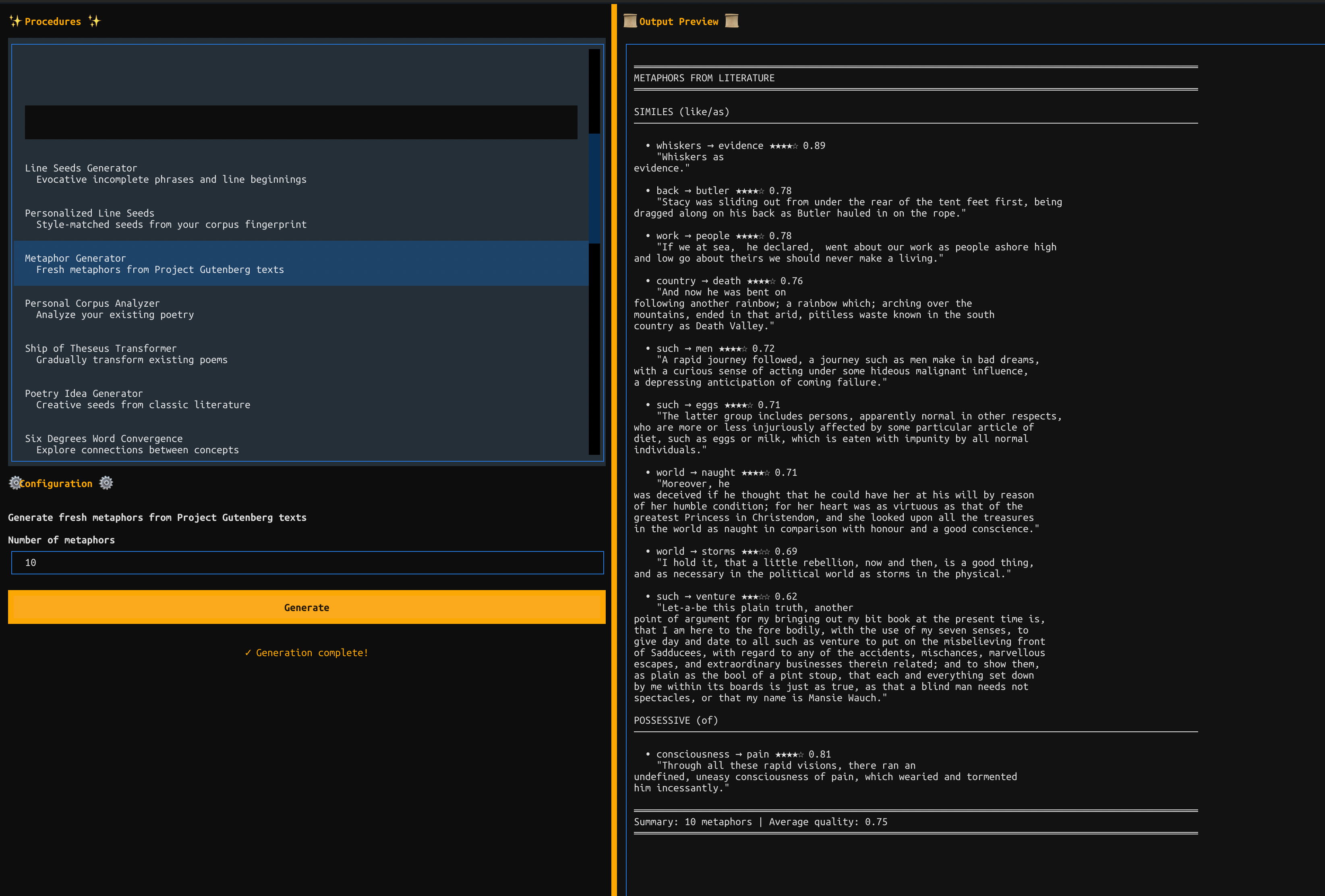
Project Gutenberg Metaphor Generator
- what interesting things can be done with calculating the levenshtein distance between two words and finding other words at the same distance?
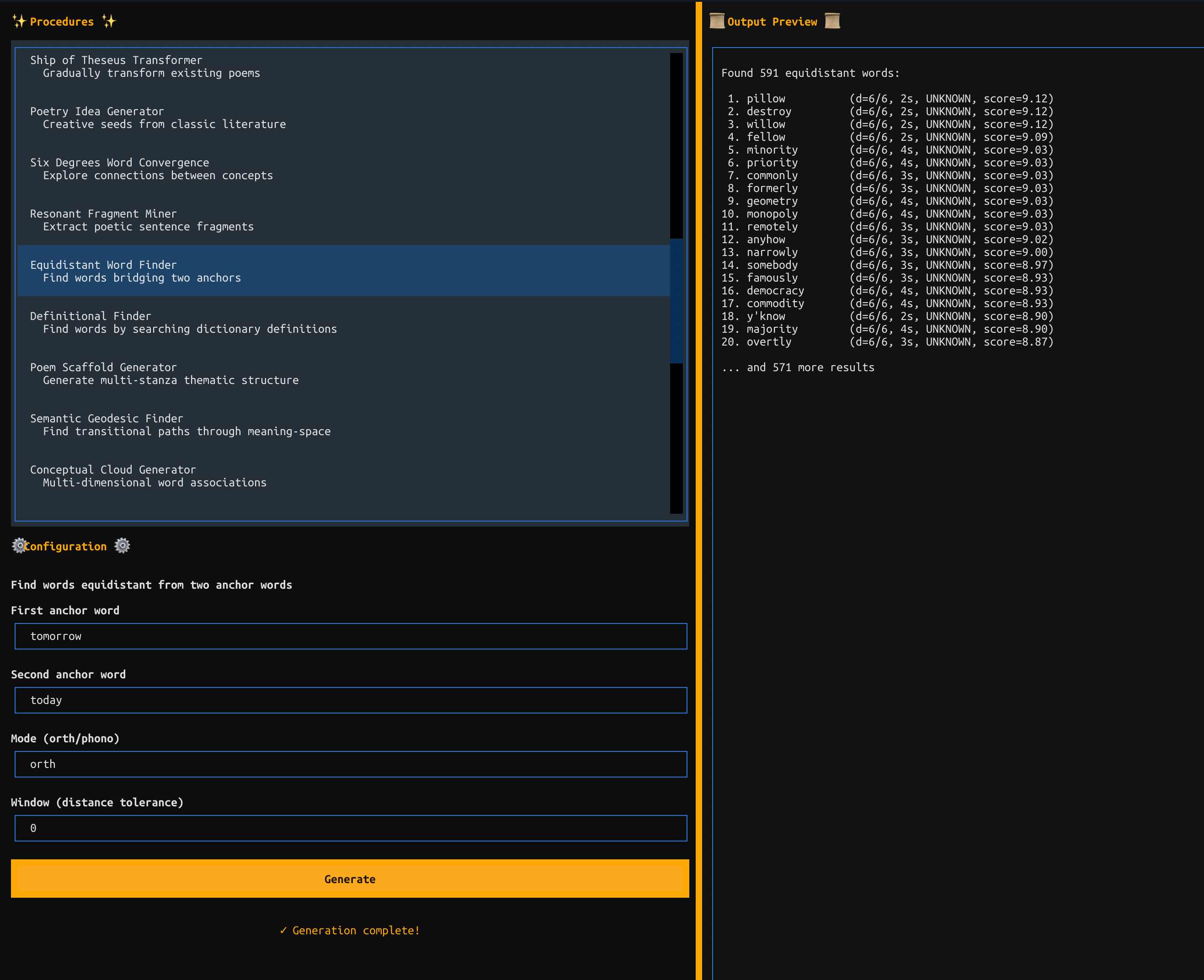
Equidistant Word Finder
- what if I took a word like “thought” and used a dictionary, but instead of looking up the word, I found every definition that has the word “thought” in it?
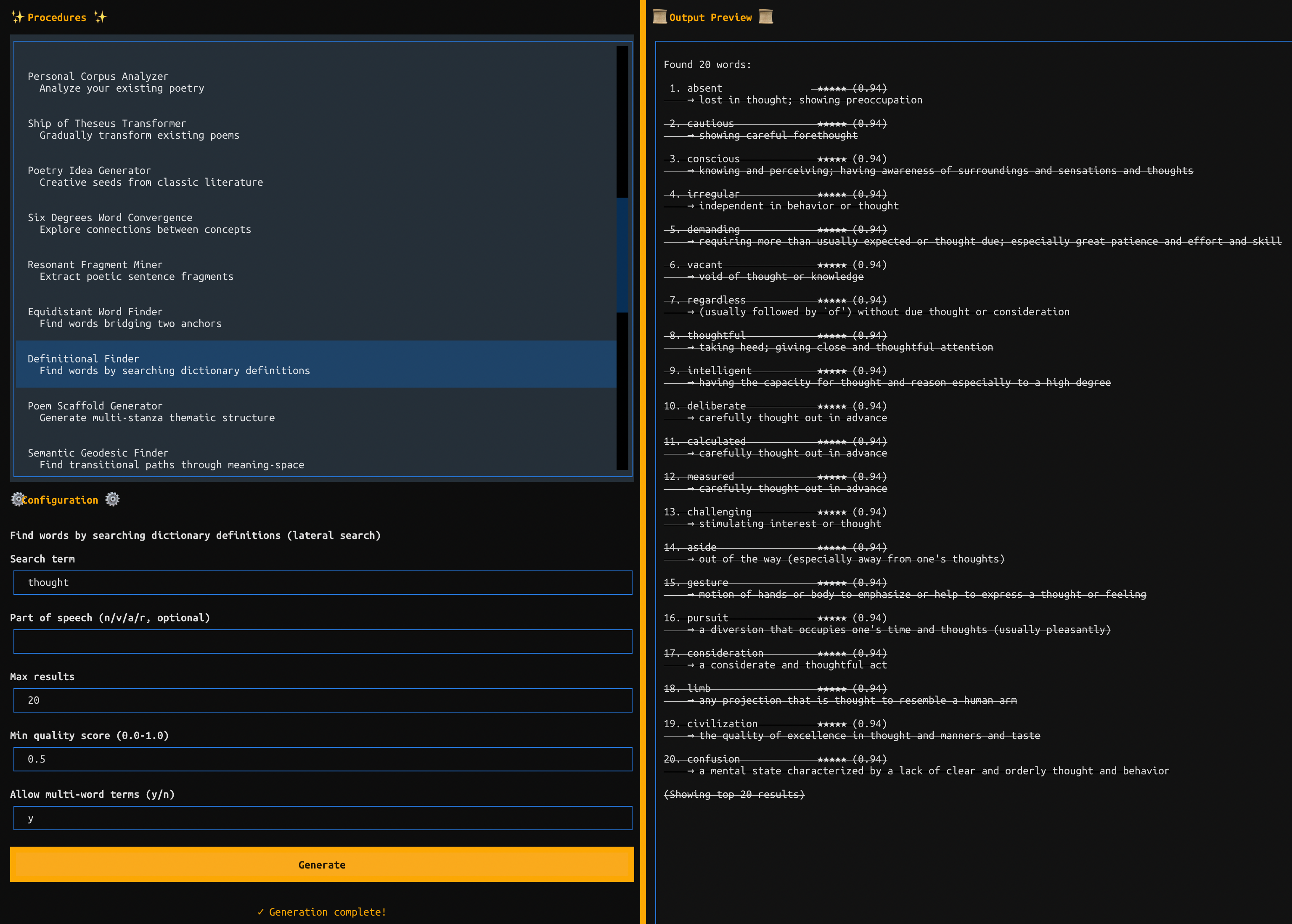
Definitional Finder
- what could I build that takes me on a word journey from a word like “hope” to “despair” in a definable number of steps?
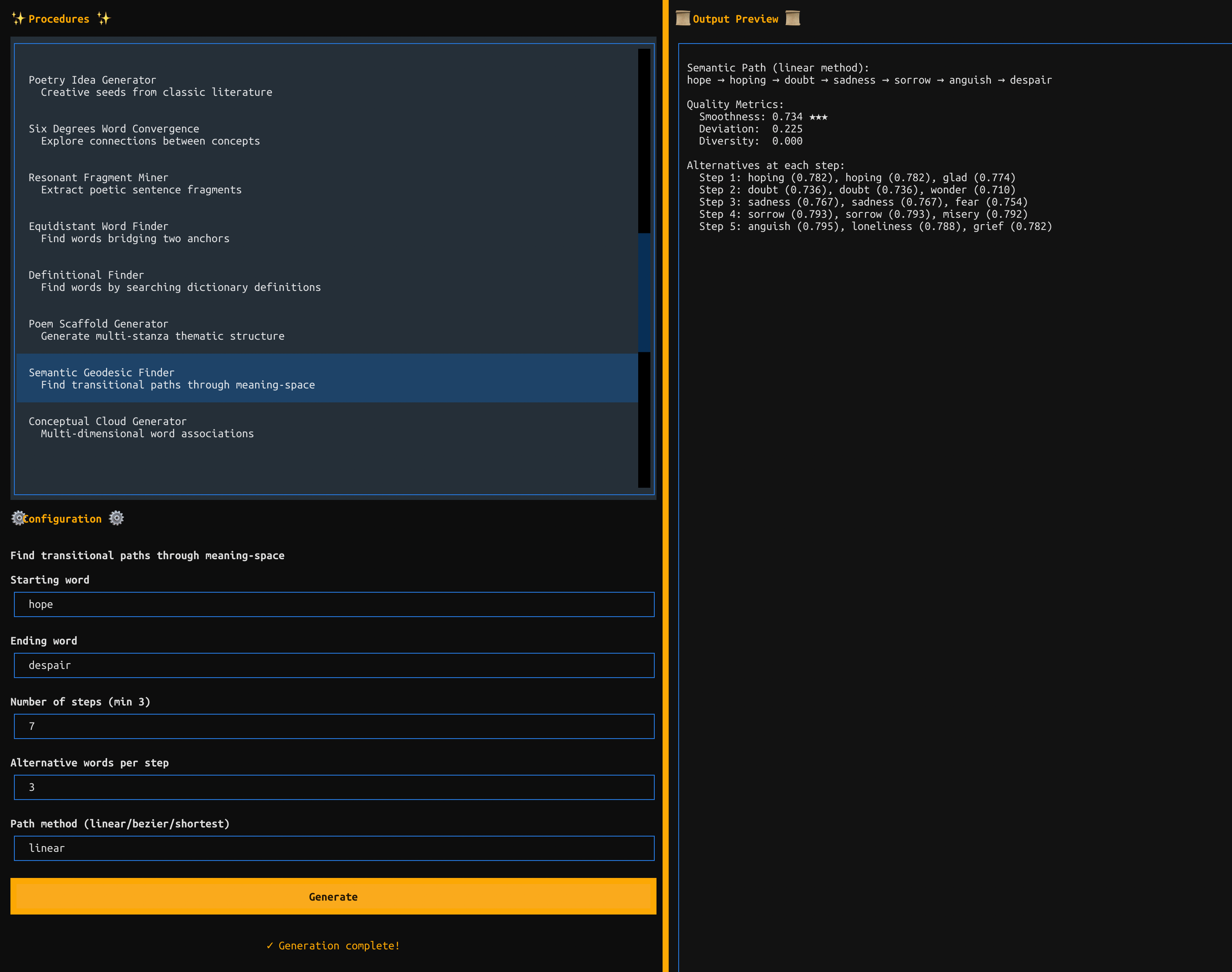
Semantic Geodesic Finder
- what if I combine a whole bunch of concepts? Say, take the output of one generator and send it into another with the overarching goal of sketching an idea for a poem. Not the poem itself, mind you, but just some words.
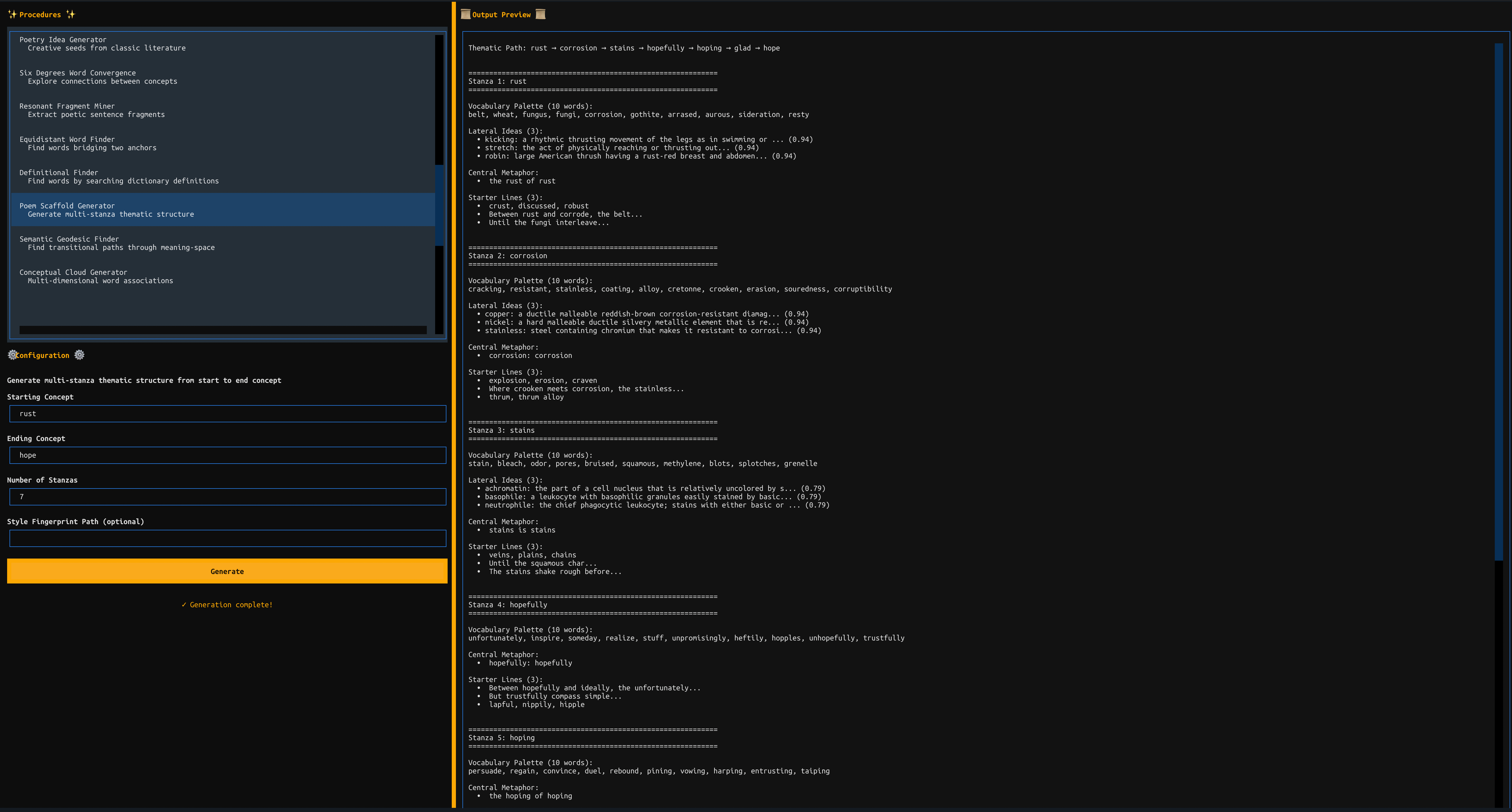
Poem Scaffold Generator
- what if want statistical and stylistic analysis of my own poetry?
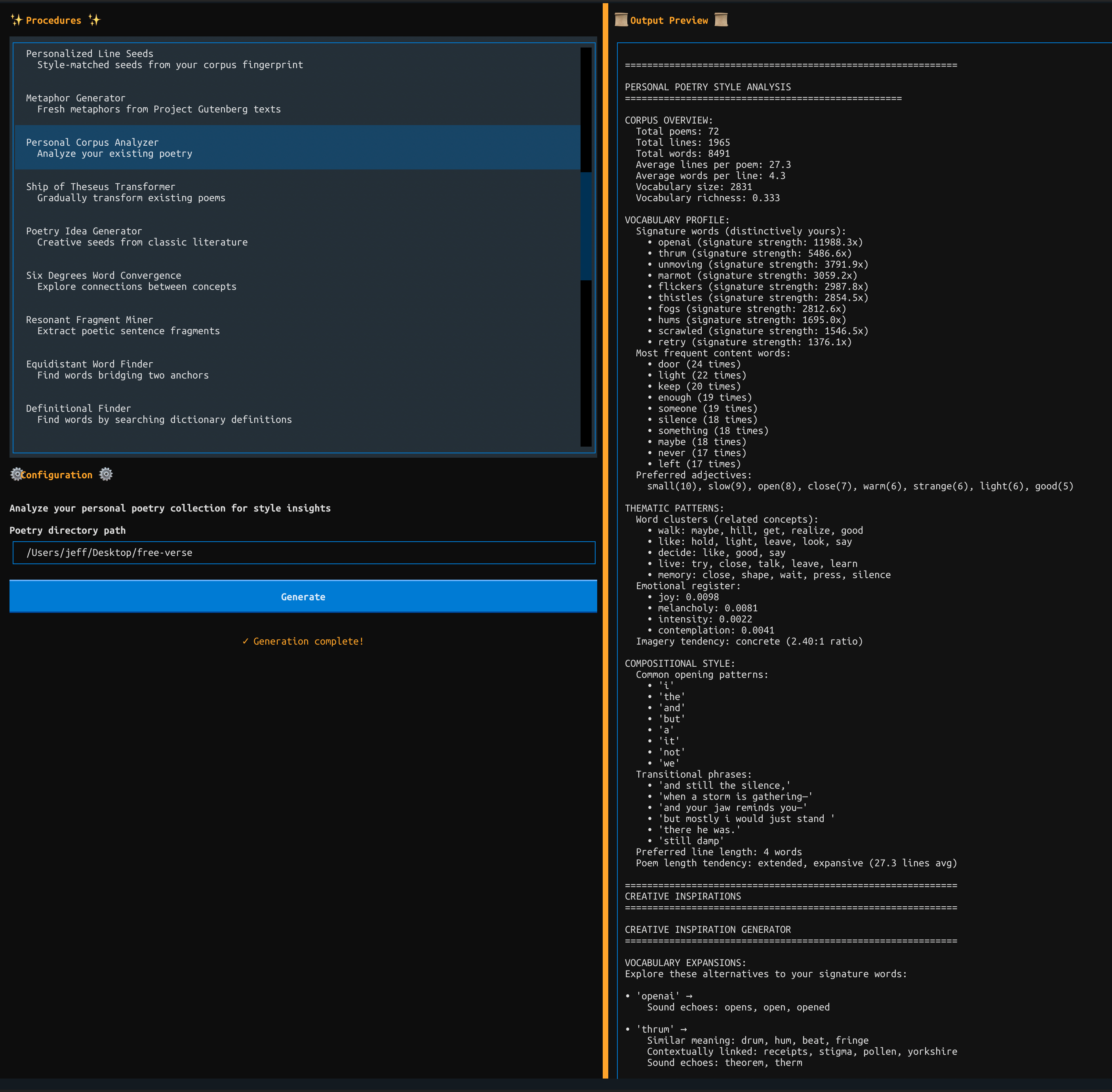
Poetry Corpus Analyzer
None of this uses Generative AI as we refer to it today. Just plain old math, machine learning libraries, and the datamuse API.
There’s more to it than this. But this description should suffice.
Good Day, My Streetsman
One thing I am proud of doing in 2025, outside of finishing a book, was writing a particular micro-poem.
In 17 syllables, I infer the existence of 3 characters, a setting, mannerisms…and then also execute a drug deal all in a character monologue.
good day, my streetsman
count albert praised your tonics—
two weeds please. thank you.
When I write these small forms, I fully inhabit them. I’m on that street somewhat unsure of how drug transactions really work, so of course I’m saying “two weeds please”. That is how we talk in my country. My horse-drawn conveyance is just over there, my good sir. Shall we take luncheon upon the morrow?
This is what I expect for the next few months into 2026 - just broadcasting my manifesto into the void to help crystallize it into reality:
- I will write dozens more of these. I use them to explore situations, voices, and general ideas without committing too much.
- Some will get expanded into longer poems
- I will read furiously throughout - The Collected Stories of Lydia Davis is already on the nightstand.
- I will start on another book.
- I will document most of it here.